On my first visit to Cuba in 1993 I fell head-over-heels in love with this quixotic, surreal island and its vivacious and resilient people. Back then (as again, sadly, now), the island was down on its knees. Cubans were struggling to survive following the fall of the Soviet Union—Cuba’s benefactor—and the ensuing collapse of the Cuban economy.
As a journalist, photographer, and subsequently as a group tour leader, my passion for Cuba has since filled my time. I’ve visited more than 200 times, led almost 150 tours, and published eight books about Cuba, including my coffee-table book Cuba Classics: A Celebration of Vintage American Automobiles (2001).

Plus, my home library boasts more than 500 Cuba-themed books by other authors, including several dozen quality picture books. I especially love photo books about Cuba. Understandable… few places on earth are so photogenic!
So it was with great delight that I received a call recently from Michael Chinnici, a New York-based documentary photographer and fellow cubaphile. “It’s my pleasure to send you my Cuba book,” he wrote in exchanges that followed. “If anyone gets a complimentary copy of my book, it has to be you, given our similarities, your photo book collection, and your long history of love and devotion to the Cuban people.”
By chance, Michael’s limited-edition photo-storytelling book, Vanishing Cuba (Red Octopus Publishing, 2022), was not yet part of my library.
What I received blew me away!
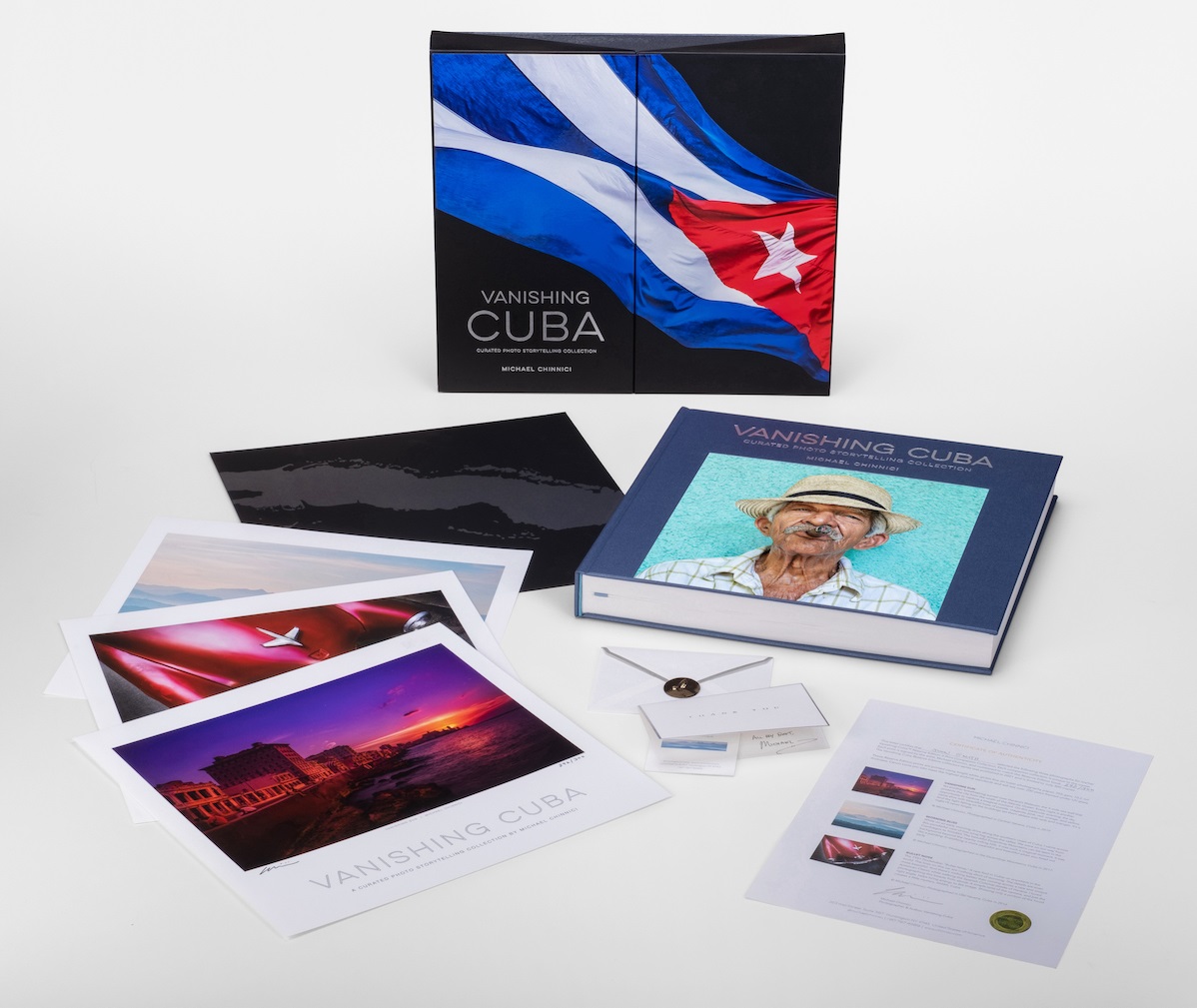
Michael graciously and generously sent me the collector’s Reserve Edition ($395).
“Simply stunning!! Beyond a work of art! I’m in awe!” I replied, unable to restrain my exclamation marks after my first brief perusal.
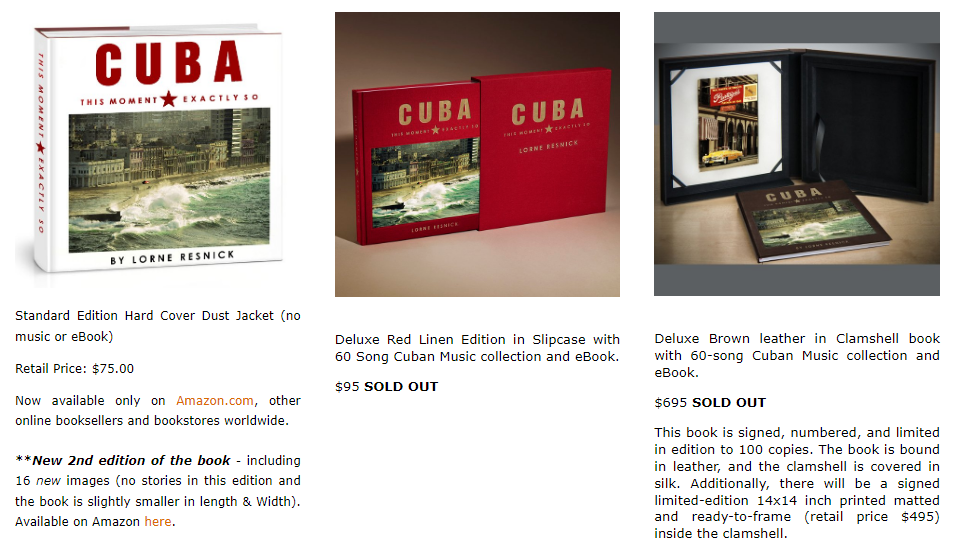
In 2017, my friend Lorne Resnick had published CUBA – This Moment, Exactly So, a one-of-a-kind fine-art coffee-table photography book, which came available in (i) a hard-cover Standard Edition with dust-jacket, (ii) a Deluxe Red Linen Edition in a slipcase with 60 Song Cuban Music collection, (iii) or—for a whopping $695—as a signed, numbered, edition limited to 100 copies bound in leather in a silk-covered clamshell slipcase, including a signed 14×14 inch ready-to-frame photo.
(Lorne had asked me to write the Foreword, but his project was delayed so many years that when finally published it featured a Foreword by celebrity writer Pico Iyer. I was able to reprise my text when photographer Jeremy Woodhouse later invited me to write the Foreword for his Cuba Through My Lens.)
Michael’s Vanishing Cuba was not inspired by Lorne’s packaging, as with his marketing and publishing background and quest for excellence, clearly he had already pre-determined to follow a similar route.
The result is the finest photo book about Cuba ever produced.
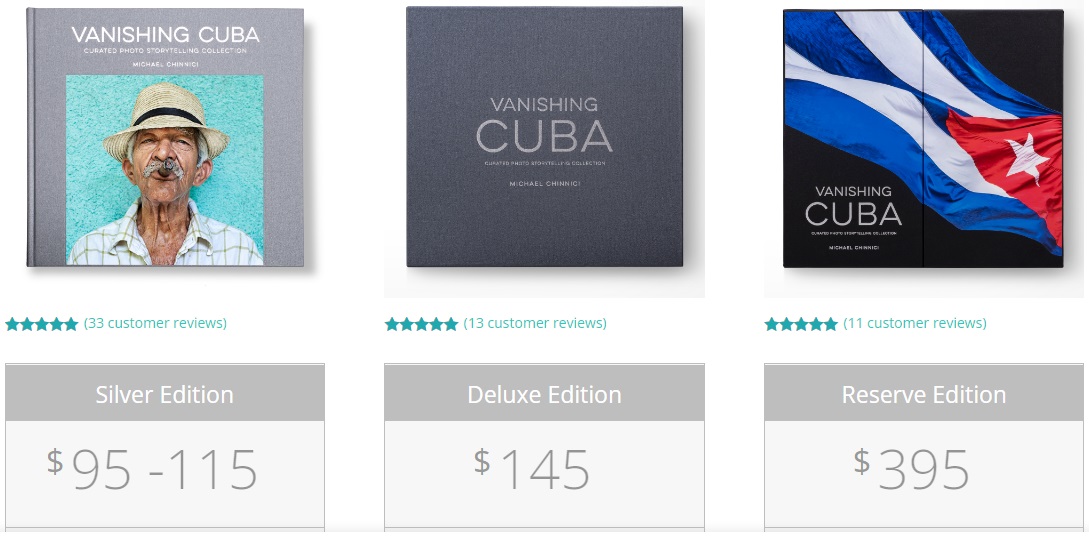
Michael has upped the ante a mile with this stunning collection of more than 300 photographs and stories from his decade-long trips to Cuba. Handcrafted in Italy with the quality of a fine Ferrari, Vanishing Cuba is available in a Silver Edition, Deluxe Edition, and a collector’s Reserve Edition.
For a more complete profile, view the following video…
Although I’d not previously seen the book, I was well aware of rave reviews. Plus, I’d been curious about Michael’s choice of title. Vanishing Cuba?
After all, no other country in the Western Hemisphere exemplifies stasis like this caught-in-the-fifties semi-derelict Hollywood movie set, instantly recognizable to even armchair travelers by its iconic Eisenhower-era American cars and its corroded and crumbling Beaux Arts and Art deco buildings and mildewed murals stained by the grime of centuries soldered into façades by the tropical heat and humidity.
Time-worn. Timeless. And utterly unique and compelling.
Yet three decades after my first visit, Cuba has changed in many ways beyond recognition. The sharp edges and sinister shadows—what I called, in the early 1990s, a novelesque land of “secret police and sexy showgirls”—have softened. Private businesses—world-class restaurants and boutique B&B hotels especially—have sprouted like mushrooms on a damp log. Internet is everywhere (sort of). And Cuban youth are addicted to their cellphones, IG, and TikTok.
“Cuba as we know it will vanish,” writes Chinnici. “It’s not a matter of whether or not it will change. It’s more a question of when it will change. And trying to imagine what a new Cuba will look like is anyone’s guess.”
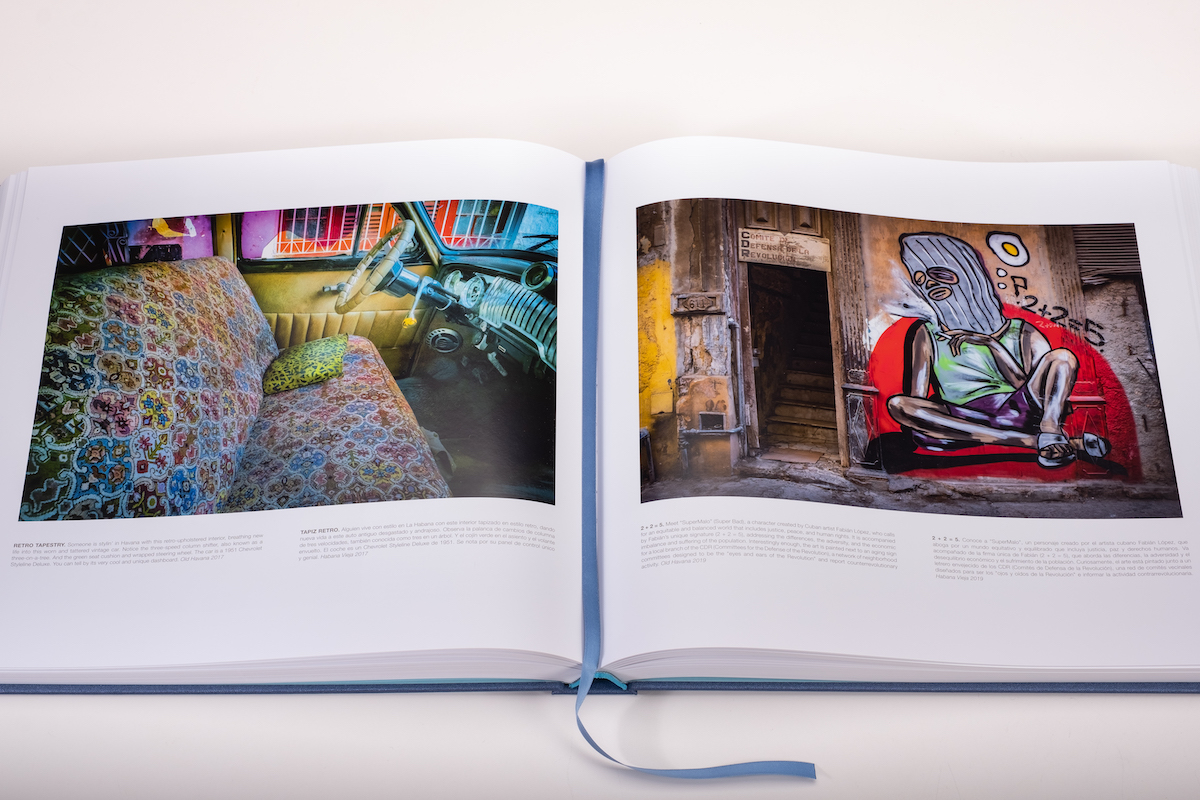
That change is already accelerating, for better or worse. (These days, I sense that even the end of the Communist government is somehow growing near, gasping for air like a newt out of water as it clings to its ever-more sclerotic and dysfunctional model in the face of a brutally punishing and unrelenting U.S. embargo.)
Today, Havana’s colonial-era and 20th-century architecture is collapsing at sobering rate. Sadly, the Malecón Tradicional seafront boulevard—once an iconic jewel of architectural glory, even as recently as a decade ago—now resembles Dresden after the bombing. The slab-like “Torre K” rascacielo (skyscraper) and other monstrous modernities (almost all are tourist hotels) now going up in Havana do not bode well for the future cityscape: see my story for OnCuba.
What Chinnici compellingly captures in Vanishing Cuba is the enduring and endearing, emotionally evocative, adorably nostalgic “Soul of Cuba.” Gritty street life. Intimate portraits of ballerinas, boxers, and weathered farmers. Insightfully composed and technically brilliant images that speak to the Cuban spirit, invoking indelible impressions, acute and profound, with every page.
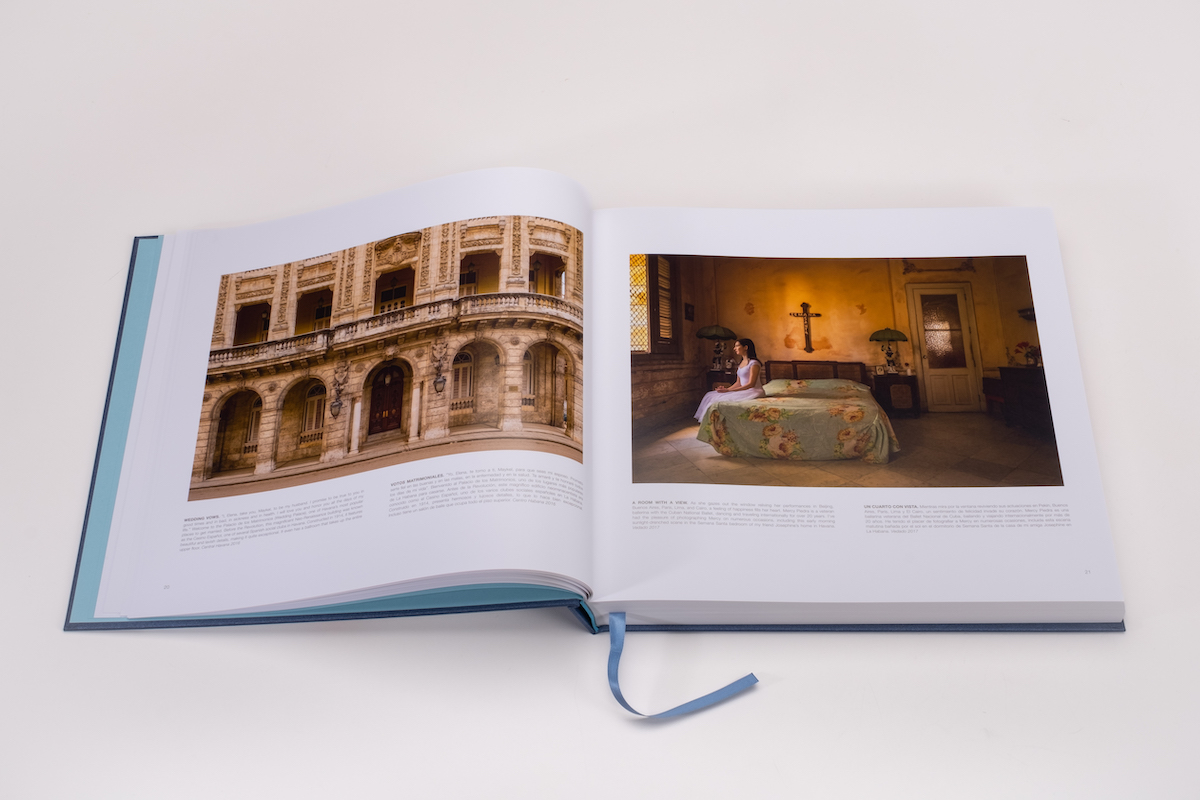
Chinnici knows Cuba. Loves Cuba. It shows, in 300 lively documentary images accompanied by compelling stories and captions (in both English and Spanish) that, above all, illustrate the amazing dignity and spirit of the many Cubans living in poverty and struggling daily with material paucity and other hardships you and I can barely imagine.
The book is divided into eleven thematic sections with titles such as Soul, Passion, Kindness, Resilience, Hope, etc., in which Chinnici shares his personal experience of falling in love with Cuba, while celebrating the Cuban character through compassionate commentary on these respective themes.
For example, in the “Sacrifice” chapter, a photo–“The glass is always half full”—shows an old lady in her humble dilapidated home. “When you see this kind of poverty, it’s hard to comprehend,” writes Chinnici in the accompanying text. “This area of Regla, across the harbor from Old Havana, is just a stone’s throw away from the capital. It’s as poor as some of the poorest villages I’ve visited in eastern Cuba and the ghetto of Santiago de Cuba. This kind of poverty shouldn’t exist anywhere in the world. Yet, for my Cuban friends, ‘the glass is never half empty, it’s always half full.’”
Soul-lifting, sanguine… and sad. That’s Cuba!
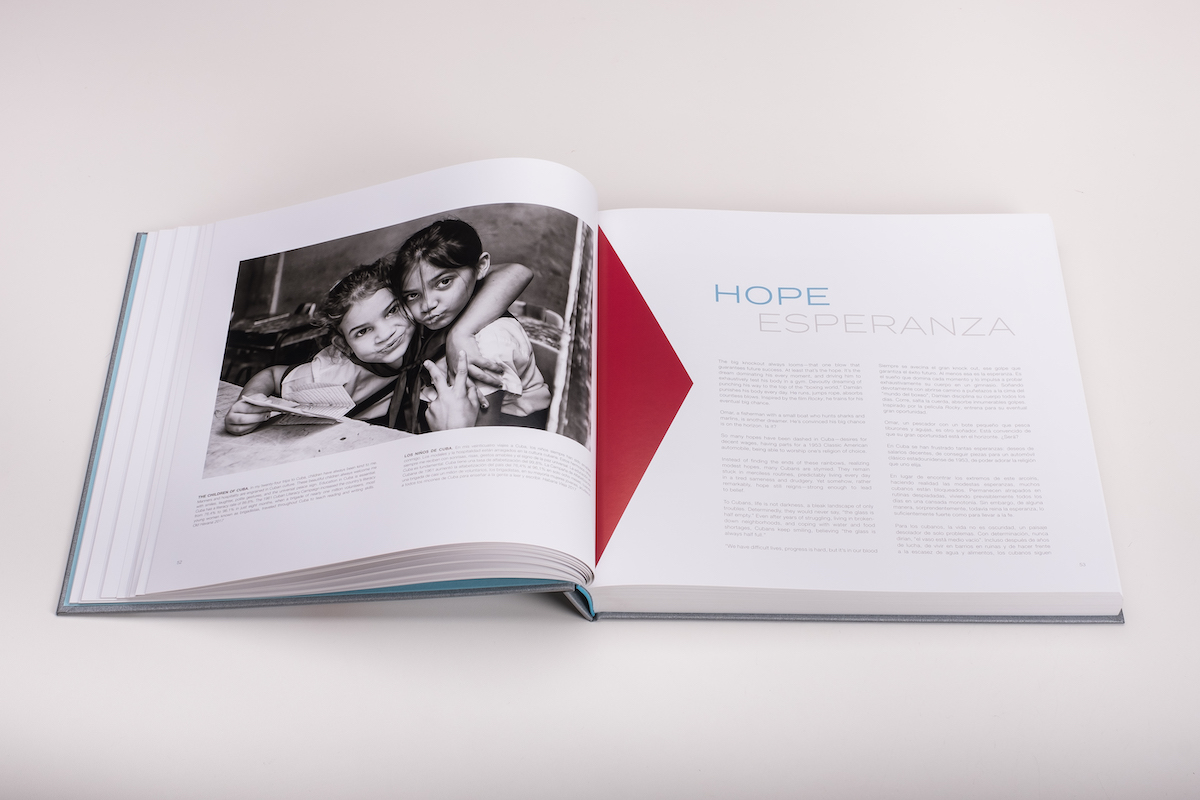
Such expressions of Chinnici’s love and caring shine throughout the book.
In his Foreword, activist artist Leonor Anthony writes: “What struck me immediately was the sincerity with which the images represented the authentic people of Cuba… These images were taken by someone who, although not Cuban, captured all of us in every single shot; all of it—the struggle, sadness, color, passion, resilience, resolve, and ultimately, the power to adjust to the unimaginable.”
Ahhh!… the lush colors!
Although Chinnici mixes in plenty of black and whites, one can’t but be amazed by the exuberant colors.
Self-published under his own Red Octopus Publishing label, Chinnici had absolute control over production standards. (He spent 25 years in marketing and design as Executive Creative Director and CEO of his own New York City advertising agency… a handy background!)
“I printed all three book editions in 11 colors (7 color Spectra System process) and 2-black and 1-grey TriTone System for black & whites, and varnish,” he wrote me. “We also did ultra-fine stochastic separations, so it’s nearly impossible to see dots in the photos. No expenses were spared, which is also why it’s self-published. No publisher would spend this.” (Chinnici details the printing technology in a separate section at the close of Vanishing Cuba.)
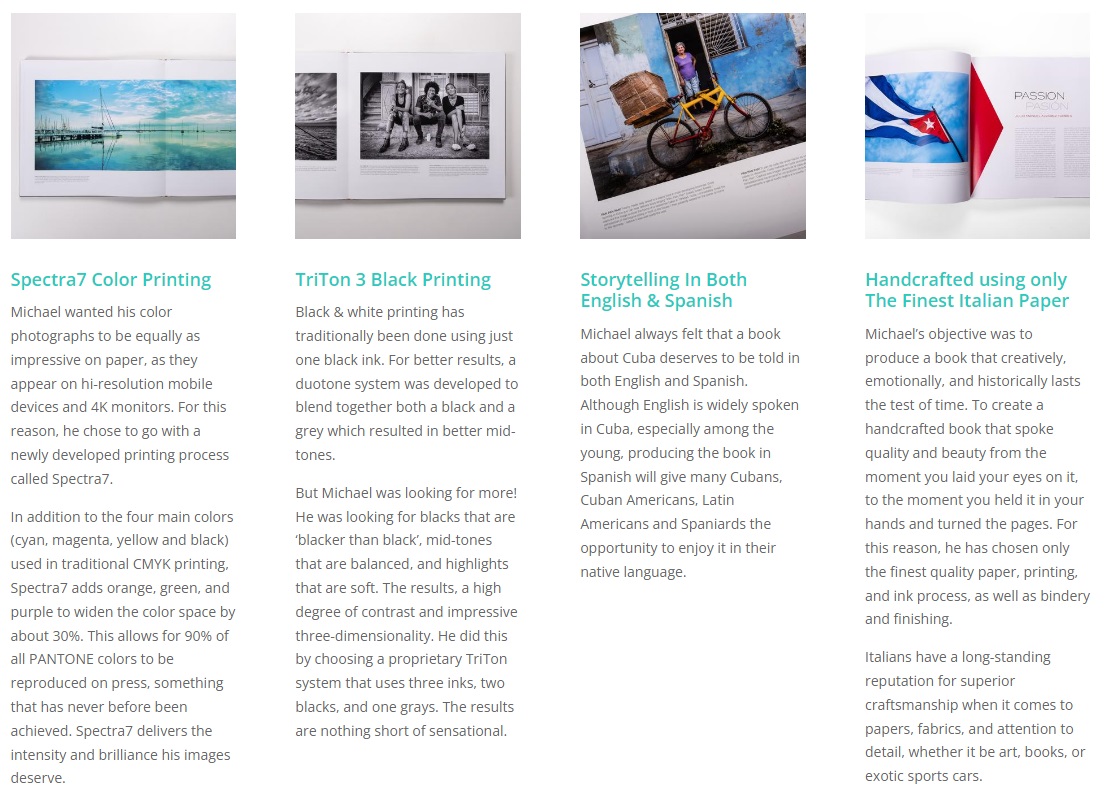
That level of care and detail in striving for definitive excellence extends to the design and layout, the high-quality semi-gloss paper, the calming typeface.
The result is truly stunning.
“You make my country look so beautiful. I know my country is beautiful, but I’ve never seen it so beautiful,” one of the people photographed told Michael when he returned to Cuba with the published book in March and May 2022.

Rachel García, owner of Finca Agroecológica Paraíso, in Viñales, after signing Vanishing Cuba.
Scrolling through the images of various subjects proudly signing a Silver Edition, I teared up, almost cried (not least because many are also my own personal friends). Such is the beauty and gracious generosity of the Cuban persona in the face of adversity that it can move you to tears.
If you’ve been there you’ll know what I mean. But even if not, browsing through Vanishing Cuba, you’ll soon comprehend why Michael Chinnici and I feel such deep affection for this incredible island and its even more incredible people. (Join Michael or myself on one of our respective photo tours to experience Cuba firsthand and learn the “art of seeing” or, as Michael says, “see the world through a new lens”.)
Michael has every reason to be proud of this gorgeous book. It stands in a league of its own, and will justifiably take pride of place on my bookcase.
ABOUT THE RESERVE EDITION BOOK (COLLECTORS EDITION)
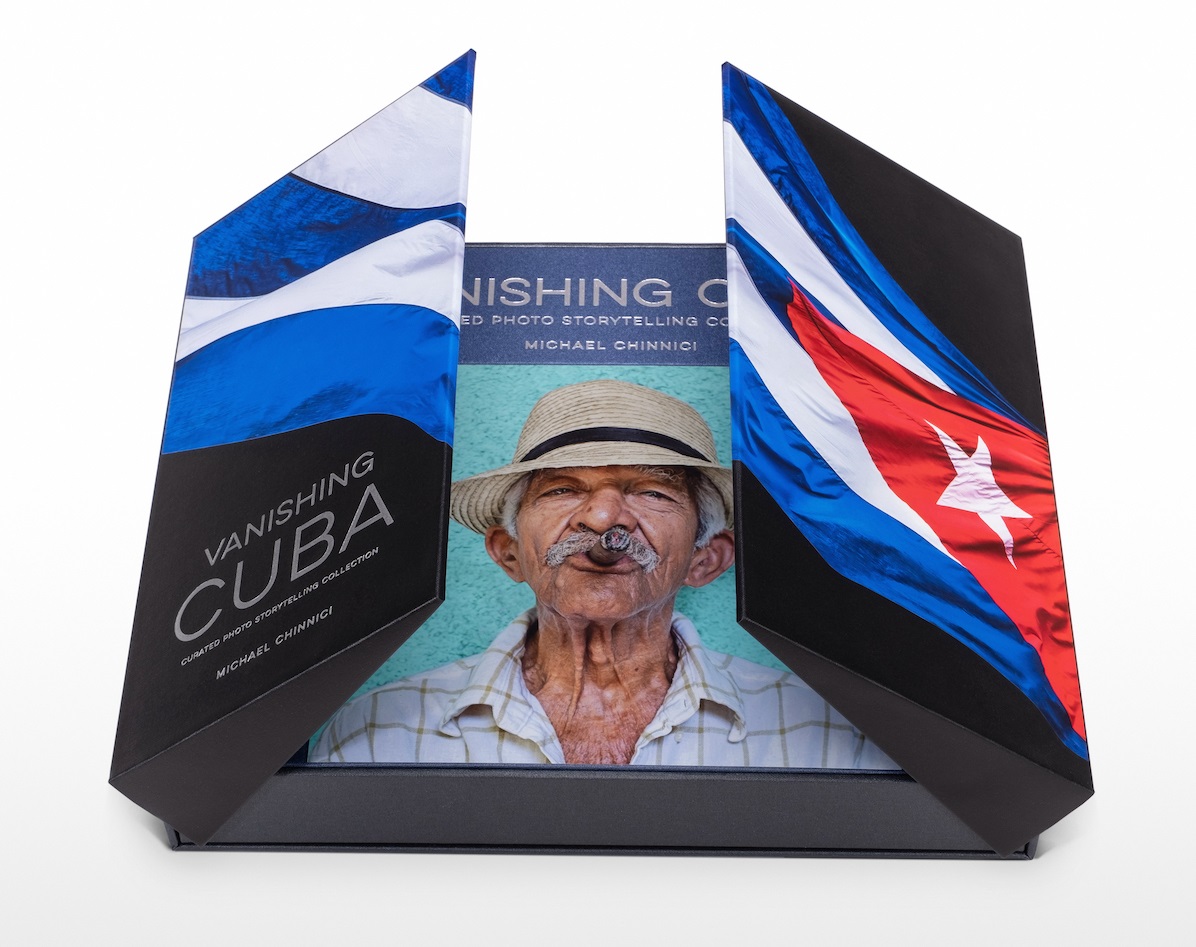
Limited to only 300 signed and numbered copies, the 348-page museum-quality Reserve “Collectors” Edition book features a unique teal cover, silk page marker, and a handcrafted clamshell center-opening jewel box that boldly features the Cuban flag. This hardcover photo book measures 12″ (31cm) x 13″ (33cm) x 1.7″ (4.4cm) and comes with a 3-Print Companion Collection of three of Michael’s favorite 12″ (31cm) x 12.5″ (32cm) archival Giclee prints, each signed and numbered to match the book’s number.